Showing posts with label France. Show all posts

Tuesday, March 26, 2013

Green invasions

It’s difficult to surprise somebody by enormous impressive installations which appear in cities and small towns all over the world. But sometimes they are so unexpected that can really astonish by their simplicity and creative approach. I want to tell you about two green installations appeared last years in the capital of Peru Lima and in small French village Jaujac.

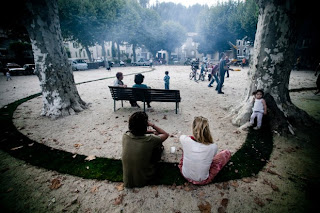
Marseilles artist Gaëlle Villedary created a project to support environment protection: almost all village’s streets and side-streets became a narrow grass-plot zones. Jaujac is surrounded by forests and rivers, but public spaces there seem very dejectedly. But this installation has covered the whole village’s centre and gave impression of a large park laid out here. It consists of 168 green rolls of total length of 1400 foots. These green paths weight 3.5 tons.

Green paths represent amazing rapprochement of natural and city conditions. Children very liked this grass-plot and it became not only good decoration but very amusing attraction.

The second example of urban environment is Peruvian capital Lima. Some years ago a city authority announced a competition for the best transformation of urban space, and the project “Invasion Verde” (Green Invasion) won and was realized.

Three Lima architects took into account a fact that Lima has very small square of green recreation zones. According to World Health Organization the green standard is 8 square meters per one citizen but in Lima it’s less in more than 4 times: 1.98 square meters.

Creative group established a park right in the city centre on the Pasaje Encarnacion (Incarnation Street). Small knolls covered by grass and green sittings were very liked by people. During the building architects and designer used second materials: car tires, altered plastics, wood.

Plants and grass also was selected carefully: they must be drought-resistant and maximally useful: they were combined a way to extract more oxygen. As a result ivy, money tree, betel palm and snake plant were planted.

As you can see these two ways of struggle with gray city reality are too simple but very eficient. Unexpected creations can change environment image sharply and attract attention to a problem.
 

by Valentin Ivanov

For more information please visit ID-reel.com 

Or join us on Facebook and LinkedIn

Tuesday, November 20, 2012

Territorial logos: good, better, the best!


Last time we started to view various territorial brandings, successful as a rule. At that time it was logos of Las Vegas and Melbourne cities. Today I’m going to tell you about logos of the New-York, Perm, Kazan cities and some countries such as Croatia, Estonia, France, Italy and Slovenia. Some of brands became better, some not so. 

New-York

The process of the New-York branding started in 80s and today we can say that its territorial branding is one of the most serious in XX century. City branding became an important strategy which has already proved its efficiency. In 1977 the New-York Commerce Department gave an order to Wells Rich Green agency to do an advertising campaign. Nobody knew that campaign will take longer than it was planned. Designer Milton Gleizer made a city logotype absolutely gratis. Suddenly it became the New York symbol. Logo is too simple and too successful that all New-Yorkers loved it and today a lot of territories try to copy this idea. But their attempts are unsuccessful: if people see “I love so-and-so” they remember about the New-York city immediately.

Kazan

This city is an example of how large-scale cultural and sport events can promote the branding starting. In fact this method proves its value: the city is in the centre of the events, all media watch it intently and all advantages and disadvantages are conspicuous. New Kazan logotype creation is connected with forthcoming World Students Games. New brand was placed even at the houses’ numbers. New motto “Thousands worlds of the New” is a symbol of interconnection of different cultures and religion living here together since the beginning of the time.

Perm
 
Well-known and one of the most expensive Russian designers offered a quite simple logotype for Perm (Пермь). By his opinion logo should be only the first letter of the city name – П. No decorations and ornaments. He offered to use this understandable and easy-to-read letter everywhere: from houses’ numbers to walls and benches. People were too amazed by Perm logo simplicity and clarity.

Estonia
 
Desire to become the European Union member made Estonia to brand actively. It was very necessary to create a proper image of this small Baltic country for Europeans, the EU members. Branding started in 2002, the project cost was about $1,000,000. The result is the logo and the motto “Welcome to ESTonia” or “Go to EST!”.

France
France is one of the most outstanding modern territorial brandings. This country endowed new logo with new images, filled it with a great number of means, and escaped of usual using of the state symbols. It is unique case in the territorial identification. New French logotype is airy, light, expressive and quite emotional. It correlates well with the idea of all country branding. That rebranding is very successful. It seems that the logo is drew by the hand, strive upwards and transforms into personal signature of France.

Croatia
 
Rebranding here was in 2006. I can’t say that restyling changed the composition a lot, rather the presentation style was transformed. New logo has more bright colours and sun cheer mood. The symbol became more attractive and pleasant visually, and doesn’t resemble those corporative red-blue colours more.

Slovenia
In contrast to the Croatian logo the Slovenian one underwent important changes. Besides the new type appeared it was worked out new image including three symbols: a lime leaf, a heart and the Slovenian mountain Triglav. But it was quite difficult for amateurs to identify all these symbols. Rather they make the logo like flame that correlates with the country branding in a strange way. And used colour decisions make it too dark and not such cheerful.

Italy
 
Italian logo had considerable changes. Old sign was rather dynamic in its composition and had a riot of colour. Traditional Italian flag colours are used in new logotype; it became more accurate and even ascetic but rich in meaning at the same time. Symbol supports the country motto “Italia leaves trace”


by Valentin Ivanov
 
For more information please visit ID-reel.com
Or join us on Facebook and Linkedin

Wednesday, October 10, 2012

Paris: Street Art Capital?


As soon as I decided to leave Paris, I've started to discover new facets of this wonderful city.
I just saw a slide show by the BBC & Lonely Planet, saying that Paris is a global capital of street art.

To watch the slideshow, click there: Paris, a global street art capital

Jef Aérosol street art Paris France

Was I wrong to have thought that NYC is much more focused on the arts in the street?
Indeed, I have often noticed the various works in the streets...
However, I've never asked about the role of Paris in the development of this artistic movement.
Should we, perhaps, consider a special tour on street art for tourists and Parisians?
What do you think, Paris is the capital of street art? Or you know one another?


by Pavel Morozov


For more information please visit ID-reel.com
Or Join us on Facebook  and Linkedin!


Monday, June 18, 2012

Why do ideas about theme parks pass by Russia?

The theme parks acquire the great popularity. But only in the West. Russians consider such projects too risky now. Why? Let’s think a little. 

For most people “park” is only “big garden or the grove with paths”. Provincial town parks in Russia are ordinary combination of benches, poor playgrounds for children, fountain as big rarity, and merry-go-rounds dangerous for life.  

There is a trend in major megalopolises to open leisure parks, but usually they look as accidental piles of various park amusements. At the same time in Europe building of theme parks (which imply not so much mindless entertainments as intelligent content) is developed actively.

Not to think is forbidden. 

There is a sense to compare the market of entertainment services in Russia and abroad. Mainly Russia has only recreation parks in the towns and entertainment complexes at the large shopping malls. And abroad it is a great industry. The PriceWaterhouseCoopers says there are more than 300 entertainment parks in Europe, and ten the largest of them are visited by more than 40 million people yearly. Paris Disneyland is the most popular in Europe (more than 10 million people annually). In the USA it is Walt Disney Park «The Magic Kingdom», Florida (15 million people). Turnover of capital of European parks is more than 3 billion euro. 

“At the last time theme parks as new segments of entertainment industry are developed actively in the West” – Yuri Yudakov, head of department office real estate, Praedium Oncor International. It is the matter about huge educational and entertainment complexes created with novel technologies. 

“We believe in intelligent relaxations” –Marcel Hatt declares, manager companion, Maxmakers (this company provides a consulting service in this field of activity). Theme parks are often opposed to American parks. “American entertainment parks are switchbacks, hamburgers and coca-cola only. No inspiration, no creation. And you’ll know nothing. On the other hand theme parks usually are intended for children to study with game” – Mr. Hatt explains. What is more theme parks offer content which is interesting both for the children and for the adults.


Foe example, more than 120 attractions of German EuropaPark are situated in 15 zones, and every of them is devoted to some European region or country. The national architecture and national features are represented there. EuropaPark offers some show-programs to its visitors. One of them is “The Journey to Times”. There are scenes with medieval knights’ tournament and audiences seats revolved round the scene. Project “Science House” offers excursions to the world of science and technology. The area more than one m2 is occupied by 80 interactive exhibits with possibility to experiment, construct and invent. Visitors can cause tornadoes by themselves, generate electricity, watch evolution of embryo. This idea focuses attention on botany, anatomy, chemistry, robotics, photonics and nanotechnology. Such a successful approach helped EuropaPark to obtain the public recognition and to get an impeccable reputation. They made entertainments’ level such high that serious people sad: “The EuropaPark is worth visiting!”. And, 4 million people have visited this place last year. 

Similar projects had been realized in other European countries. So, there is a theme park “City of Sciences and Arts”(Ciudad de las Artes y las Ciencias de Valencia) in Spain. This successfully functioning park was projected by famous architects Santiago Calatrava and Felix Candela. The park consists of the following zones: Arts Palace, concert complex, exhibition centre, cinema, planetarium, centre for laser shows, greenhouse, interactive science museum, park of oceanography. The most popular here is the science museum which motto is “Forbidden not to think, not to feel, not to touch!”. The Ocean park has more than 500 animals from all over the world and a series of ecosystems of the Earth.

Fifty-fifty. 

Of course, entertainment and theme park are not charitable projects. The cause of their financial success is a good combination of entertainment infrastructure and commercial objects such as hotels, cafes, restaurants and shops. It’ll give synergetic result, repeated effect. After visiting of theme park visitors should go not to parking but to entertainment zone with souvenir shops, cinemas and restaurants. According to Marcel Hatt, 50% of theme parks’ incomes are receipted from entertainment and attractions and other 50% is extra service. Additional services are parking, food, hotel accommodation, holding conferences, gift shops, educational and scientific objects. 

Hotel complexes EuropaPark Resort is situated here, it occupies an area of 27 hectares. It consists of five hotels, camping and tent village with the total capacity near 4.5 thousand places. Capacity of the hotels exceeds 90%. Besides it there are more 200 hotels and pensions in 14 municipalities located side by side with park. 

In Danish Tivoli Gardens there are 38 cafés and restaurants for 10 thousand people. Here you can visit Chinese and Turkish restaurants, coffee-houses and bakeries, de luxe restaurants with author’s cuisine from famous chief cooks. Not long ago de luxe hotel was opened, and every room was designed individually. 

“It is better to plan theme parks with other components, it’ll give an opportunity to make a loan from bank and reduce owned capital. So, if you will ask for a credit only for theme park, you’ll get only 20–30% of capital you need. But if it will be multifunctional project the correlation of owned capital and loan one will be fifty-fifty. It is possible to get 80% of necessary financing with office component. 

In addition theme parks could be excellent area for a brand showing. America has well-developed film industry, and usually entertainment and theme parks are created at movie studios. Disney, Universal, Paramount and Lego invest to the theme parks and promote film heroes in such way. It’s interesting that large automobile concerns are not indifferent to the theme parks. So the hugest attraction in EuropaPark (height of Silver Star is 70 m) was created in collaboration with Mercedes-Benz. 

Experts think that people are bored with countless trade-entertainment centers in Moscow and other Russian cities. And huge theme park would be very called-for. Especially as because prospective target audience of theme parks is quite wide: families with children, schoolchildren and preschoolers. But for some reasons Russian and foreign investors fear to build theme parks in Russia taking into account high risks. A lot of good projects remain on paper still. 

It should be stressed that incidents with failure of theme parks were abroad also. Here is a typical example. The first Swiss theme park “Mystery Park” was founded on writer Erich von Däniken’s initiative in 2003 at the place of former military airfield. After its opening project received the serious state support and also got the reward Milestone, it’s Swiss prize for quality and innovations in tourism. During first 100 days the park was being visited by 200 thousand people that was more than organizers expected in 40%. But the next year the flow of visit has decreased. Things were moving worse and worse, and in 2006 Mystery Park had became bankrupt and had closed. Swiss Academy of Technics called Mystery Park as “Cultural Chernobyl”. By experts’ opinion indistinctness of the conception, unchanging exhibition and low involvement of local touristic business were main causes of Mystery park’s closure. Space Park in Bremen suffered the same fate: its infrastructure and attractions had gone out of date though some years after its launch. 

It’s considered such parks should have possibilities for an organic development. Russian investors only make a helpless gesture: “Development implies land resources, investments and technical re-equipment”. 

They are not satisfied with payback period also. Sometimes it may be more than 10 years, not to speak of technical and other risks. For example, factories producing the attractions now have quite modest output and are overdriven today. 

Therefore many potential investors show preference to projects of sports specialization, for example skating-rinks or ski-resorts. It’s explained easily because entertainment park requires incomparably large territory. Taking into account land prices today only government support can attract an attention of investors. Moreover entertainment park is very power-hungry enterprise an infrastructure problems will be not solved by private company itself. 

It should be noted that state and municipality quite often support projects of the theme parks’ building. For example, Spanish “City of Sciences and Arts” was founded thanks to Valencia administration. It’s interesting that city has obtained it by dreaming of not only new jobs but cultural and service center in contrast to popular Barcelona and Seville.


By Valentin Ivanov
For more information please visit ID-reel.com
Or Join us on Facebook  and Linkedin!

Friday, June 15, 2012

Sex appeal in Place Marketing


Nowadays there is a small tending, which can be recognized as extraordinary or, moreover, vulgar. However, there are some varieties of examples of the concept of sexuality in a rapidly increasing business area known as territorial marketing or place marketing.


Here we go. Tel-Aviv, the business capital of Israel, now got branded as a new gay and lesbian capital: Tel-Aviv Gay Vibe. Guess what, English-German investment equal to the amount of 88.1 US dollars is directing over there. So that, it will promote a gay-tourism with the following resorts, shopping routes, etc. This is a good point of applying the term “sexuality” to place marketing.
The campaign is detailed on the website: 
http://telavivgayvibe.atraf.com/
Tel Aviv invites you to have fun, be free and feel fabulous!


Also, there is an ad made by Swiss company in purpose to promote Switzerland as a location of European Football Championship-2008. Quite cute, it shows a beautiful European nature and countryside with unusual appeared workers. Worth seeing. 


However, there are some pointless and awkward examples of doing so. The first one is Poland. The Bolkestein directive, which allowed to a Polish company to work in France according to Polish conditions and not the French ones. And, it caused one inconvenient for seeing a concept or fact called “Polish Plumber” (in French: “plombier polonais”). 


The second example is Georgia. Not the American one, the ex-USSR one. And there is nothing to say, just total misunderstanding. What is it? Kind-of-sexy man called Tbilisi is branding the name of Georgian capital flirting with young women. Moreover, they took money from the city budget to shoot and advertise this slightly erotic video. You must see it.


To sum up: sex appeal as a mean of attractiveness must be applied with a great accuracy to avoid the experience of Georgia, with some humor like Switzerland or Poland, or direct to the point for the minority as Tel-Aviv not without the risks...


As for other conclusions, they are always welcome in the comments below :)

References:


By Sergei Makarov
For more information please visit ID-reel.com
Or Join us on Facebook  and Linkedin!

Tuesday, March 27, 2012

Theme parks: when history try its revival to catch the tourists


France again: Napoleon is back!
BBC News, by Hugh Schofield, 26 March 2012.


ID-réel:
In our work we are pushing up the topic of theme parks: it is one of the best ways to promote the region, its history, its traditions. BUT: any theme park is a BUSINESS project: the main goal is to attract the tourists and to make them pay for the entertainment they have. The best exemples apart Disneylands arround the world, the theme parks as Futuroscope in Poitier, Puy du Fou in Vendée or Médinat Alzahra in Tunisia. The real explosure of the theme parks are linked to the big need of new experiences in leisure, short trips and in the same time, the babyboomers time in Europe & USA.


Plans are afoot to build a theme park based on the life and times of the French leader Napoleon Bonaparte. Can it be a tourist magnet to rival nearby Disneyland Paris?

You have heard of Napoleon the emperor, the general, the reformer, the lover. Of the humble Corsican who took destiny by the throat, whose armies marched through Europe, bringing subjugation yet also emancipation.

And how he was stopped at the gates of Moscow, fought a last hurrah at Waterloo, and died in Atlantic exile.

So maybe you will be interested in the latest attempt to memorialise this greatest of Frenchmen. Because coming some time soon at a location not far from Paris, it's Napoleon… the theme park.

Far from being the whim of a madcap entrepreneur, it is an entirely serious project with the backing of government, tourism officials and the Bonaparte family.

Assuming the money can be raised - and everyone thinks it will be - then the first stone of Napoleon's Bivouac (for that is its name) will be laid on 18 February 2014, the 200th anniversary of the battle of Montereau.

The battle of where? Montereau is not the most famous of Napoleon's encounters. Austerlitz it ain't. It was fought in what became known as the France campaign of 1814, as the emperor tried in vain to hold back the advancing coalition armies.

At Montereau, 90km (55 miles) south-east of Paris, he scored a small but brilliant victory over the Austrians. Legend has it that it was here - when loyal soldiers expressed fears for his safety - that Napoleon uttered the much-quoted words: "Fear not my friends. The bullet that will kill me has yet to be cast!"

The victory made little difference to the course of the war, and a few weeks later Napoleon was forced to abdicate at Fontainebleau.

But it remained etched in the memory of the town. A statue of the emperor on horseback dominates the main bridge, and there are annual re-enactments by uniformed enthusiasts. More importantly, by virtue of being one of his very few victories on French soil, Montereau is seen as the perfect spot for a Napoleonic tourist centre.

"Experts will look into what kind of attractions we could include in the park," says Yves Jego, mayor of Montereau, and driving force behind the project. "They mustn't be vulgar, but fitting for the stature of the man."
Actors in armour and on horseback during a reenactment at Le Puy du Fou theme park Le Puy du Fou is a template for success

For those who find it hard to imagine how a theme park could be based on so important - and indeed controversial - a historical character, supporters have a stock answer. Don't compare us to Disneyland Paris, they say. Think more of Le Puy du Fou.

Le Puy du Fou is a historical theme park, telling the story of the people of the Vendee in western France. With five elaborate outdoor spectacles - replete with battle-scenes, pyrotechnics and a cast of hundreds - it draws in some 1.5 million visitors a year.

The Bivouac could do something similar. Provisional sketches show a park divided into regions - France, Russia, the Orient and so on - with reconstructions of sites from Napoleon's life such as the Pyramids and the Gates of Moscow.

There'll be battle re-enactments, and perhaps rollercoasters and water-rides. The promoters also want computerised exhibits based on the latest in video-gaming.


"A theme park is a fantastic way to teach young people about history," says France's tourism minister Frederic Lefebvre.

"A park that tells of the life of Napoleon - the good sides as well as the bad - will, I am convinced, prove of interest to people the world over."

Lending authority to the project is the man who currently heads the Bonaparte family, Charles Napoleon. A descendant of the emperor's younger brother Jerome, he dismisses the notion that it will trivialise his illustrious forebear.

"In the past people learned history by reading. Then they learned history by going to museums, or by seeing films. In the 21st Century, people need a new medium for history - and that medium is the theme park," he says.

Charles Napoleon is concerned about historical accuracy, but he places his faith in a committee of experts which will keep a close eye on the project.

Because Napoleon means different things to different groups of people. The Poles regard him as a saviour, with a name-check in their national anthem. For the Russians, he was a brutal invader. The Spanish rose up against him, and were ruthlessly suppressed. But many in Italy thanked him for casting off the Austrian yoke.

As for the British, they have a particular relationship with the man who for so many years was their bitterest foe. There is a school of British historiography which is especially critical of le petit caporal, seeing him as a prototype for later destiny-inspired war-mongers such as Hitler.

This infuriates Charles Napoleon.

"Do you judge Winston Churchill by the 30,000 he killed in one night in the air raids over northern Germany? Of course not," he fumes.

"Yes, Napoleon made war. But behind the French armies came new institutions, new administrations, new rules - all inspired by the French revolution, by equality and justice. It was liberation through conquest."

In France too, historical opinion remains divided - so divided that children learn plenty about the Revolution, but history lessons then take a sudden leap forward to 1871 and the coming of the Third Republic.

His legacy is awkward because even though Napoleon put in place many of the institutions which make up modern-day France (the Banque de France, departments, Legion d'honneur and so on), he also crowned himself emperor and waged war on the rest of Europe.

Particularly troubling for the political left are his re-establishment of slavery, and the subordination of women in his civil code.

Not that any of this matters to those the theme park will be principally aimed at. The real genius lies in its appeal to new tourists - those already arriving in France in their tens of thousands but soon in their millions: the Indians, the Russians, the Brazilians. And above all the Chinese.
Chinese tourists taking photos of the Arc de Triomphe in Paris France is keen to woo Chinese visitors

"China is our most important potential market, and there Napoleon is a vital strategic asset," says Christian Mantei, head of tourism development agency Atout France.

"They love his image as a military genius, as an epic hero and a self-made man. He is a killer brand."

Charles Napoleon agrees.

"The French have a difficult relationship with their history. It all moved so fast, so inevitably people are deeply divided over Napoleon's achievements. But go abroad - especially to China or India or Japan - and you immediately see that he is the best-known French man all over the world.

"That's why we have to build this park. Because if we don't do it soon, you can be absolutely sure the Chinese will get there first."